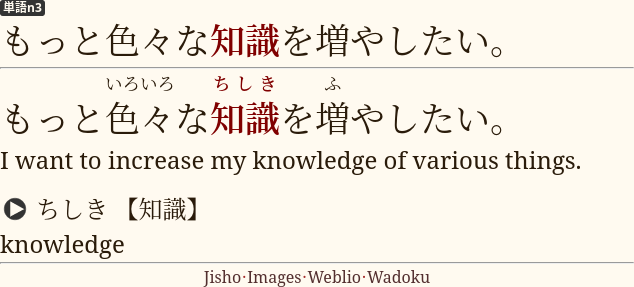
A card from the Tango N3 sub-deck.
## What's Included? * 8,000 cards, or from 300 to 800 days of vocabulary study. * Authentic, full, native example sentences. * Authentic native audio. * Translations for every sentence. * Vocabulary definitions. * Kanji readings. ## Download Visit a link below to download the original Ankidrone deck. ## Tango books *Ankidrone Essentials* contains sentences extracted from *JLPT Tango* textbooks. JLPT Tango textbooks are designed to prepare for the JLPT. There are five books total, one for each level of the JLPT. The books include vocabulary found commonly on the test and often used in everyday life. Cards are ordered in such a way that most sentences only introduce a single new word or grammar pattern. The order of cards and focus on words commonly used in daily life in Japan makes this Anki deck an ideal instrument to complete the basic vocabulary stage. ## How to study 1) Learn all cards from Tango `N5`. 1) Start [sentence mining](sentence-mining.html) using TV-shows with Japanese subtitles, and later manga and novels. > **[Sentence mining](sentence-mining.html)** is the process of finding sentences > with words you don't know in your immersion and making them into sentence cards. > Programs like [GoldenDict](setting-up-goldendict.html) > or the browser add-on > [Rikaitan](setting-up-yomichan.html) > simplify this process to a single click. > [mpvacious](https://github.com/Ajatt-Tools/mpvacious) > is an add-on for > [mpv](https://wiki.archlinux.org/index.php/Mpv) > that works similarly to > [subs2srs](our-immersion-learning-toolset.html#subs2srs) > and can be used together with Rikaitan > to create Anki cards while watching subtitled content. You'll learn more about sentence mining on the subsequent pages of this guide. 1) While sentence mining, learn Tango `N4`, `N3` and `N2` at a reduced pace. It is critical not to spend too much time on beginner decks and focus on mining. 1) The rest can be used to aid your learning process later. The higher level you reach, the less benefit from premade decks you will get. Refer to Core10k when you have trouble finding example sentences. Remember that you have to combine your study with
[immersion](introduction-to-learning-japanese.html#how-to-immerse)
from the beginning.
Humans absorb language only through repeated massive exposure.
Anki can help you learn the vocabulary consciously,
but it cannot replace or substitute immersion.
Anki is used to help you reinforce and strengthen your memory,
notice and recognize the learned words in native Japanese.
**Note:** If you have completed [Ankidrone Foundation](jp1k-anki-deck.html),
skip Tango `N5` because they teach roughly the same words
and differ mostly in their card templates.
For more information, read [this article](difference-between-foundation-and-essential-decks.html).
## How to review
To understand how to review basic vocabulary decks,
refer to [How to review](basic-vocabulary.html#how-to-review).
Key points:
* Try to recall the meaning and reading of the **marked word**.
* Use the context to understand how the word connects with other words.
* Press "Good" if your guess is correct. Otherwise, press "Again".
* Don't use the "Hard" and "Easy" buttons.
Install [AJT Flexible Grading](https://ankiweb.net/shared/info/1715096333) to hide them.
## Tips
* See [basic vocabulary tips](basic-vocabulary.html#tips).
* If `.webp` and `.ogg` files do not load properly in AnkiDroid on Android,
update AnkiDroid [to the latest Alpha version](https://github.com/ankidroid/Anki-Android/releases/).
Media sync can take a while.
You need to sync your collection with AnkiWeb and wait for it to finish.
* In the Tango books they teach many country names.
The purpose of learning them is apparently to understand self introductions
as well as be able to give one yourself.
You can skip them without losing too much.
* Feel free to skip katakana-words, loan-words.
Most people who speak English can already understand them intuitively.
* People ask me why I added this or that card in the deck.
I simply copied everything that was present in the **Tango** books.
Delete cards you don't like.
There is no "curriculum" in AJATT, there are no "must know" words.
You'll learn everything eventually.
* Sometimes you'll see that the same word appears in more than one sub-deck.
E.g., a word appearing in the `N4` deck and also appearing in the `N2` deck.
If you know the word already, it's fine to delete or suspend the other card.
## Do I have to finish the entire deck?
I [recommend](basic-vocabulary.html#how-to-study)
that you learn at least 1,000 and up to 2,000 cards
before you start mining your own sentences.
The rest of the deck is supplementary material to assist during sentence mining.
There are more cards in Ankidrone Essentials than needed to complete the beginner stage.
Is it bad? No, I don't think so.
You learn only the cards you want to learn.
Providing more high quality TSCs is better than providing less,
since you can delete the cards you don't like and still be left with a decent amount of TSCs.
Having access to high quality example sentences is important for a language learner.
## Sources
* Tango `N5` and Tango `N4` decks were shared by Anonymous from DJT.
* Tango `N3` was shared by [Perditio](https://ankiweb.net/shared/info/519347273).
* Tango `N2` was [made by a team of volunteers](jlpt-tango-n2-anki-deck.html#credits).
* Tango `N1` was [made by a team of volunteers](jlpt-tango-n1-anki-deck.html#credits).
## Changelog
**Changes in version 8:**
* Fixed a number of typos, especially in the `N1` and `N2` decks.
* Improved definitions.
* Replaced audio in the `N5` deck.
* Fixed vocab audio in the `N3` deck.
* Tagged katakana words.
* Populated the `Notes` field for all sentence cards.
* Katakana-words are suspended by default. Most English speakers already know them.
* Country names are suspended by default. Beginners don't really benefit from learning them.
* Updated the bundled note type.
* Bundled usage instructions.
**Changes in version 7:**
* Added JLPT Tango `N1`.
* Fixed small mistakes.
**Changes in version 6:**
* Added JLPT Tango `N2`.
**Changes in version 5:**
* Added word audio to TSCs in Tango `N3` and Tango `N4`.
* Fixed small mistakes.
**Changes in version 4:**
* Converted all remaining sentence cards to TSCs
**Changes in version 3:**
* Added JLPT Tango `N3`.
* Added a separate note type for SWCs to distinguish them from sentence cards.
* Improved definitions on SWCs
* Added pronunciations to SWCs that didn't contain any audio
* Fixed typos in JLPT Tango `N5` (Thanks [zofpz](https://matrix.to/#/@zofpz:matrix.org))
**Changes in version 2:**
* Audio files were repacked, silence trimmed, bitrate increased.
* Included a description explaining how to use the deck.
* Core10k vocabulary sorted using the [Netflix frequency list](https://t.me/ajatt_tools/18).
## Feedback
The deck still has room for improvement.
Please share any feedback, suggestions, or corrections you have in our chat.
[Join us](join-our-community.html).
Remember that you have to combine your study with
[immersion](introduction-to-learning-japanese.html#how-to-immerse)
from the beginning.
Humans absorb language only through repeated massive exposure.
Anki can help you learn the vocabulary consciously,
but it cannot replace or substitute immersion.
Anki is used to help you reinforce and strengthen your memory,
notice and recognize the learned words in native Japanese.
**Note:** If you have completed [Ankidrone Foundation](jp1k-anki-deck.html),
skip Tango `N5` because they teach roughly the same words
and differ mostly in their card templates.
For more information, read [this article](difference-between-foundation-and-essential-decks.html).
## How to review
To understand how to review basic vocabulary decks,
refer to [How to review](basic-vocabulary.html#how-to-review).
Key points:
* Try to recall the meaning and reading of the **marked word**.
* Use the context to understand how the word connects with other words.
* Press "Good" if your guess is correct. Otherwise, press "Again".
* Don't use the "Hard" and "Easy" buttons.
Install [AJT Flexible Grading](https://ankiweb.net/shared/info/1715096333) to hide them.
## Tips
* See [basic vocabulary tips](basic-vocabulary.html#tips).
* If `.webp` and `.ogg` files do not load properly in AnkiDroid on Android,
update AnkiDroid [to the latest Alpha version](https://github.com/ankidroid/Anki-Android/releases/).
Media sync can take a while.
You need to sync your collection with AnkiWeb and wait for it to finish.
* In the Tango books they teach many country names.
The purpose of learning them is apparently to understand self introductions
as well as be able to give one yourself.
You can skip them without losing too much.
* Feel free to skip katakana-words, loan-words.
Most people who speak English can already understand them intuitively.
* People ask me why I added this or that card in the deck.
I simply copied everything that was present in the **Tango** books.
Delete cards you don't like.
There is no "curriculum" in AJATT, there are no "must know" words.
You'll learn everything eventually.
* Sometimes you'll see that the same word appears in more than one sub-deck.
E.g., a word appearing in the `N4` deck and also appearing in the `N2` deck.
If you know the word already, it's fine to delete or suspend the other card.
## Do I have to finish the entire deck?
I [recommend](basic-vocabulary.html#how-to-study)
that you learn at least 1,000 and up to 2,000 cards
before you start mining your own sentences.
The rest of the deck is supplementary material to assist during sentence mining.
There are more cards in Ankidrone Essentials than needed to complete the beginner stage.
Is it bad? No, I don't think so.
You learn only the cards you want to learn.
Providing more high quality TSCs is better than providing less,
since you can delete the cards you don't like and still be left with a decent amount of TSCs.
Having access to high quality example sentences is important for a language learner.
## Sources
* Tango `N5` and Tango `N4` decks were shared by Anonymous from DJT.
* Tango `N3` was shared by [Perditio](https://ankiweb.net/shared/info/519347273).
* Tango `N2` was [made by a team of volunteers](jlpt-tango-n2-anki-deck.html#credits).
* Tango `N1` was [made by a team of volunteers](jlpt-tango-n1-anki-deck.html#credits).
## Changelog
**Changes in version 8:**
* Fixed a number of typos, especially in the `N1` and `N2` decks.
* Improved definitions.
* Replaced audio in the `N5` deck.
* Fixed vocab audio in the `N3` deck.
* Tagged katakana words.
* Populated the `Notes` field for all sentence cards.
* Katakana-words are suspended by default. Most English speakers already know them.
* Country names are suspended by default. Beginners don't really benefit from learning them.
* Updated the bundled note type.
* Bundled usage instructions.
**Changes in version 7:**
* Added JLPT Tango `N1`.
* Fixed small mistakes.
**Changes in version 6:**
* Added JLPT Tango `N2`.
**Changes in version 5:**
* Added word audio to TSCs in Tango `N3` and Tango `N4`.
* Fixed small mistakes.
**Changes in version 4:**
* Converted all remaining sentence cards to TSCs
**Changes in version 3:**
* Added JLPT Tango `N3`.
* Added a separate note type for SWCs to distinguish them from sentence cards.
* Improved definitions on SWCs
* Added pronunciations to SWCs that didn't contain any audio
* Fixed typos in JLPT Tango `N5` (Thanks [zofpz](https://matrix.to/#/@zofpz:matrix.org))
**Changes in version 2:**
* Audio files were repacked, silence trimmed, bitrate increased.
* Included a description explaining how to use the deck.
* Core10k vocabulary sorted using the [Netflix frequency list](https://t.me/ajatt_tools/18).
## Feedback
The deck still has room for improvement.
Please share any feedback, suggestions, or corrections you have in our chat.
[Join us](join-our-community.html).